
Table of Contents
If you’ve been hearing about robotic knee surgery and wondering what makes it special, you’re not alone. I’ve followed medical tech for years, and this one genuinely deserves the hype. It’s not science fiction—it’s a proven advancement that’s reshaping how knee replacements are done.
Let’s walk through what makes robotic-assisted knee arthroplasty such a big deal, and why so many patients and surgeons are now choosing it.
What Exactly Is Robotic Knee Surgery?
When I first learned about robotic knee replacement, I imagined a robot performing surgery on its own. That’s not the case. It’s a team effort — the surgeon controls everything, and the robot helps with precision.
Before surgery, doctors create a 3D model of your knee using a CT scan. This model helps plan your patient-specific implant placement down to the millimeter. During the procedure, the robot assists the surgeon to ensure implant alignment accuracy and smoother movement.
You still have an expert guiding the process; the robot just adds precision no human hand can match.
How Robotic-Assisted Knee Arthroplasty Works
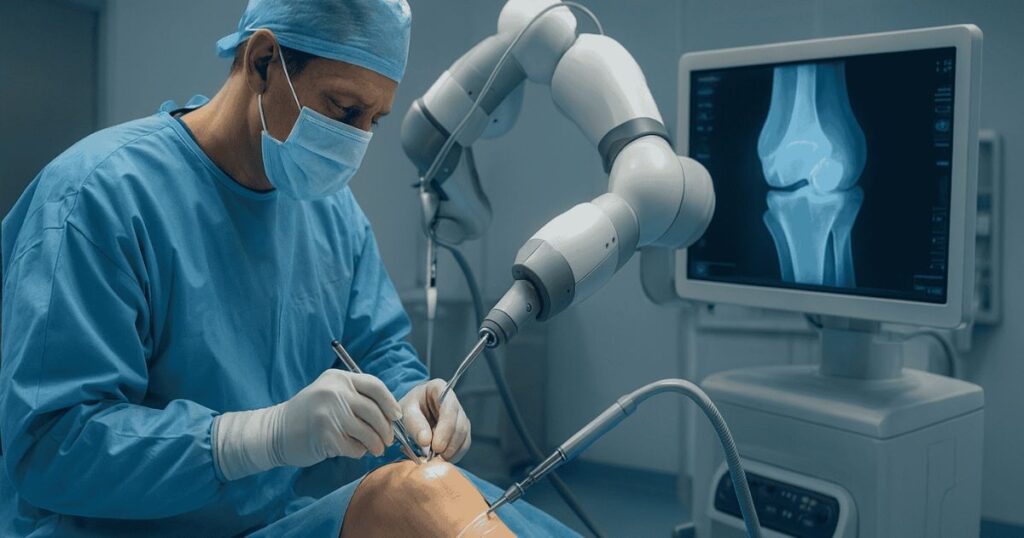
This is where technology truly shines. In robotic knee surgery, a robotic arm-assisted system is programmed using your personalized 3D knee model. It maps out exactly where to cut and place the implant.
As the surgeon operates, the system provides haptic feedback — gentle resistance that prevents tools from going beyond safe limits. Think of it as a safety net that protects your tissues.
The surgical navigation system also tracks every movement in real time, ensuring the implant is perfectly aligned. The result? Fewer complications, faster recovery, and an overall better outcome.
Why Surgeons Prefer Robotic Knee Replacement
Surgeons love precision, and robotic-guided knee surgery gives them exactly that. The technology allows them to see a real-time 3D view of your knee during surgery. This means they can make tiny adjustments on the spot to preserve soft tissue and achieve natural joint motion or kinematic alignment.
Even in partial replacements like unicompartmental knee arthroplasty (UKA), where only one side of the joint is replaced, robotic assistance ensures unmatched accuracy. Studies show it often leads to fewer revision surgeries and a faster return to daily life.
In short: the surgeon stays in charge, but the robot makes them sharper.
Robotic vs. Conventional Knee Replacement
Let’s be honest — robotic knee surgery costs more. But that higher price comes with measurable benefits. Traditional surgery depends entirely on manual measurements and surgeon skill, while robots bring consistent, data-driven accuracy.
Here’s what really sets them apart:
- Precision: Robots can position implants within one millimeter of the plan.
- Customization: Each implant is tailored to your unique anatomy.
- Recovery: Shorter hospital stays and quicker rehabilitation.
- Outcomes: Better functional results and reduced pain.
Patients also experience lower revision rates, meaning the chances of needing another surgery later are significantly reduced.
Step-by-Step: What Happens During Robotic Knee Surgery
If you’ve ever wondered how it actually works, here’s a quick breakdown:
- Imaging & Mapping – A CT scan builds a detailed 3D model of your knee to plan every step.
- Preoperative Planning – The surgeon studies the model and fine-tunes the surgical plan.
- Robotic Assistance – The robotic arm guides the surgeon’s instruments with pinpoint accuracy.
- Haptic Feedback – The system prevents unwanted cuts or excessive bone removal.
- Verification – Real-time data confirms the implant fits perfectly before the incision is closed.
That’s how robotic-assisted total knee arthroplasty maintains such impressive accuracy and consistency.
The Learning Curve and Technology Behind It
Not every surgeon picks it up overnight. There’s a learning curve, but once mastered, robotic knee arthroplasty becomes incredibly efficient.
Each robotic surgical system — like Mako, ROSA, or VELYS — works slightly differently but shares one goal: better surgical precision. Some even use AI and predictive algorithms to make micro-adjustments during the operation, based on how your knee moves.
It might take a little longer to set up, but the precision it delivers saves patients from years of discomfort and extra surgeries.
Benefits of Robotic Knee Surgery for Patients
Patients often notice the benefits right away. Here’s what makes it worth considering:
- Smaller incisions and less scarring.
- Faster recovery and earlier mobility.
- More natural knee movement due to better alignment.
- Less pain after surgery.
- Higher satisfaction rates thanks to accurate results.
If precision, personalization, and quick recovery matter to you, robotic knee replacement checks all the boxes.
Cost and Accessibility
Yes, robotic knee surgery is more expensive upfront. But if you look at the bigger picture — lower complication rates, shorter hospital stays, and longer-lasting implants — the investment makes sense.
Many hospitals are now adopting this technology, and as it becomes more common, the costs are expected to come down. It’s similar to how other advanced medical tools eventually become standard.
The Future of Robotic Knee Surgery
The future of robotic orthopedic surgery goes beyond replacement. Researchers are already integrating artificial intelligence in knee arthroplasty to predict surgical outcomes before the procedure even starts.
Soon, we might see robots capable of semi-active adjustments, learning from millions of past surgeries to enhance precision even further.
The combination of human expertise and machine learning could make joint replacement safer and more efficient than ever.
Recovery and Post-Surgery Experience
Patients who undergo robotic-assisted knee replacement often walk within a day of surgery. Since there’s less tissue damage, pain and swelling are usually lower, and rehabilitation focuses on strength and balance rather than managing discomfort.
Because implant positioning is so precise, these knees tend to last longer with fewer complications. For most people, that means getting back to walking, climbing stairs, and living life comfortably within weeks.
Challenges and Limitations
To keep it real — this technology isn’t perfect yet.
- The cost remains a major barrier in some regions.
- There’s still a learning curve for surgeons.
- Some short-term studies show results similar to traditional surgery.
But as more surgeons adopt it and the technology evolves, these gaps are steadily closing.
My Take on Robotic Knee Surgery
If you ask me whether robotic knee surgery is worth it, I’d say yes — for the right patient. The level of precision, reduced pain, and faster recovery make it a smart investment in your mobility and comfort.
It’s not about replacing the surgeon — it’s about giving them the most accurate tools to help you move pain-free again.
FAQs About Robotic Knee Surgery:
1. Is robotic knee surgery really better?
Yes, it offers higher precision, faster recovery, and better implant alignment than traditional surgery.
2. How painful is robotic knee surgery?
Pain is usually less due to smaller incisions and minimal tissue damage during surgery.
3. What is the recovery time for robotic knee surgery?
Most patients recover in 6–8 weeks and return to normal activities faster than with manual surgery.
4. What is robotic knee surgery?
It’s a computer-assisted procedure where a surgeon uses robotic guidance for accurate implant placement.
5. Which knee surgery is better, robotic or manual?
Robotic surgery is more precise and consistent, while manual surgery depends heavily on surgeon experience.
6. Who is a candidate for robotic knee surgery?
People with severe arthritis or knee pain unrelieved by medication are ideal candidates.
Conclusion:
After exploring all the facts, one thing stands out clearly: robotic knee surgery isn’t just a trend — it’s the future of joint replacement. The blend of human skill and robotic precision is redefining what’s possible in orthopedic care.
If you’re considering knee replacement, talk to your surgeon about robotic-assisted arthroplasty. It might just be the difference between a decent outcome and a truly life-changing one.
In short, this technology delivers exactly what modern medicine promises — precision, personalization, and performance.